
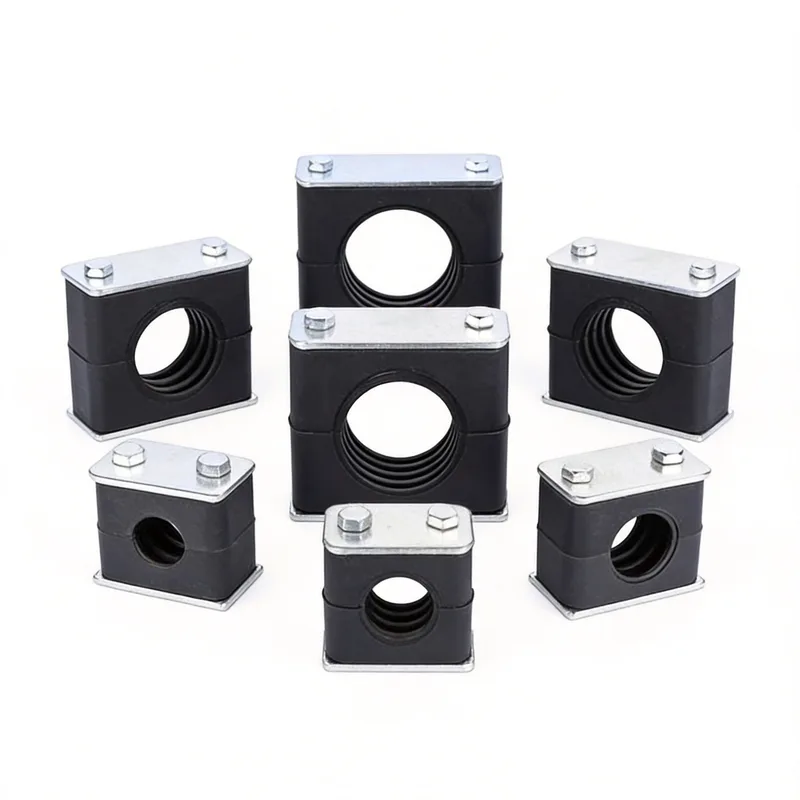
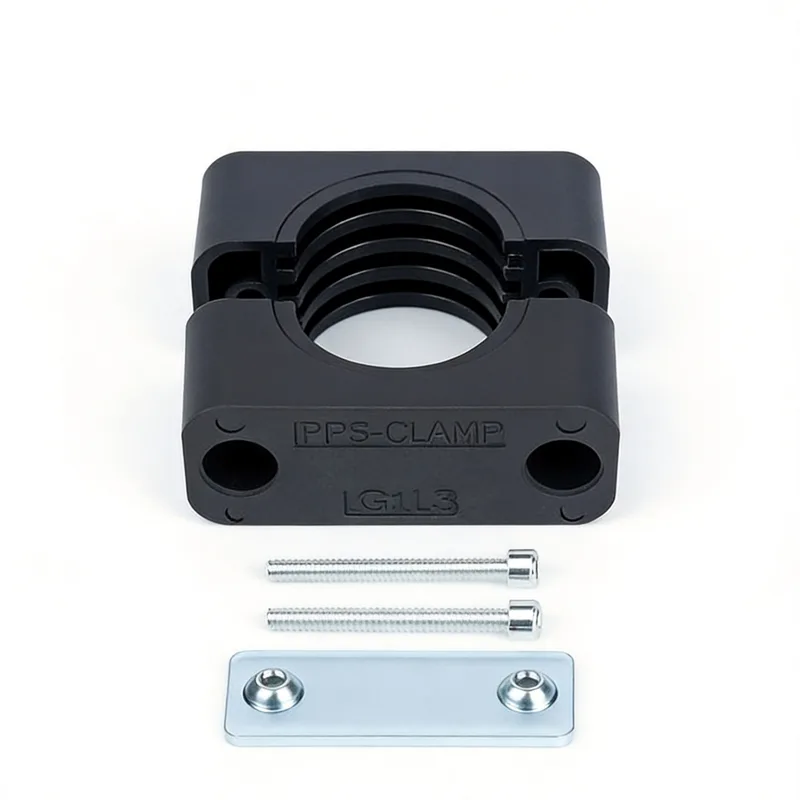
When a pipe clamp body is described simply as "polyamide" or "nylon" or "PA", that single label hides important differences. The three polyamide grades commonly used for DIN 3015 clamp bodies — PA6, PA12 and PA66 — share the same basic polymer family but differ significantly in moisture absorption, temperature capability, impact toughness and cost. Choosing the wrong grade can lead to a clamp that swells and loses clamping force in humid conditions, becomes brittle in the cold, or softens near a heat source. This article compares the three grades across the properties that matter for pipe clamp service and gives practical guidance on which to specify for each environment. Understanding these differences also helps when a manufacturer offers "nylon" clamps at very different price points — the cheaper option is often standard PA6, while the premium is PA12 or glass-filled PA66.
Related product photos
Key points
- PA6 is the lowest-cost grade but absorbs the most moisture (up to 3% at saturation), causing dimensional swelling and loss of stiffness in humid or wet service
- PA12 absorbs the least moisture (around 0.7%) and stays dimensionally stable, making it the best choice for wet, humid or outdoor service and for thermal-cycling environments
- PA66 has the highest temperature rating and stiffness (especially glass-filled) but is more notch-sensitive and brittle at low temperature than PA6 or PA12
- For most general industrial DIN 3015 clamps, dry PA6 is adequate; upgrade to PA12 for wet/outdoor and to PA66 only when temperature or stiffness demands it
| Property | PA6 | PA12 | PA66 (often glass-filled) |
|---|---|---|---|
| Moisture absorption (saturation) | High (~2.5–3.0%) | Very low (~0.7–1.5%) | Moderate (~1.5–2.5%) |
| Continuous service temp. | ~80–100 °C | ~80–90 °C | ~100–120 °C (higher when glass-filled) |
| Low-temperature impact | Good | Excellent (best of the three) | Fair — more brittle, notch-sensitive |
| Stiffness / load capacity | Moderate | Moderate (slightly lower) | High (especially 30% glass-filled) |
| Chemical resistance | Good to oils/fuels; weak to acids | Best of the three to chemicals/fuels | Good; similar to PA6 |
| Relative cost | Lowest | Highest (specialty grade) | Moderate to high |
Values are typical for unfilled grades unless noted. Glass-fibre reinforcement (commonly 30%) raises stiffness, temperature rating and dimensional stability of any polyamide but reduces impact toughness and makes the material more notch-sensitive. Exact figures vary by compound and supplier — always confirm against the manufacturer data sheet.
Moisture absorption: the property that separates the grades
The single most important difference between PA6, PA12 and PA66 for pipe clamp service is moisture absorption. Polyamides are hygroscopic — they absorb water from the surrounding air and from direct contact with liquids. As the polymer absorbs moisture, it swells dimensionally and the absorbed water acts as a plasticiser, reducing stiffness and increasing toughness. PA6 absorbs the most: at saturation in a humid environment it can take up 2.5–3.0% of its weight in water, swelling by a corresponding amount. For a clamp body, this swelling changes the bore dimension and can either over-tighten on the pipe (raising stress) or, more commonly, the plasticising effect softens the body so it creeps under bolt preload and loses clamping force over time. PA12 absorbs the least — around 0.7–1.5% at saturation — because its longer carbon chain between the amide groups makes it more hydrophobic. This is why PA12 is the preferred grade for wet, humid, submerged or outdoor applications where dimensional stability matters. PA66 sits in between, closer to PA6. The practical consequence: a "nylon" clamp tested dry in a catalog may behave very differently after months in a humid plant, and the magnitude of that change depends entirely on which polyamide grade it is made from.
Temperature capability and the effect of glass filling
For continuous-service temperature, PA66 has the edge over PA6 and PA12, particularly in glass-filled form. Unfilled PA6 and PA12 are rated to roughly 80–100 °C continuous; unfilled PA66 reaches about 100–120 °C; and 30% glass-filled PA66 can be used continuously at higher temperatures still, with much greater retention of stiffness near the upper limit. The reason is twofold: PA66 has a higher melting point (around 255 °C versus around 220 °C for PA6 and around 178 °C for PA12), and glass fibres carry load even as the polymer matrix softens with heat. This makes glass-filled PA66 the grade of choice for clamps near heat sources — engine bays, steam tracing, hot process lines — where unfilled grades would soften and creep. However, glass filling has a downside: the fibres create stress concentration points that reduce impact toughness and make the material more brittle, especially at low temperature and at notches such as the bolt hole. A glass-filled PA66 clamp that performs well at 120 °C may crack if struck by a tool at −10 °C. The selection logic is therefore: use glass-filled PA66 when sustained temperature or load demands it, but not as a default, and not for cold-climate outdoor service where impact resistance matters more than heat resistance.
Impact toughness and cold-weather behaviour
Impact toughness — the ability to absorb a sudden blow without cracking — matters for clamps that may be struck during installation or maintenance, knocked by passing equipment, or subjected to impact loads from water hammer or mechanical shock. Among the unfilled grades, PA12 has the best impact toughness, particularly at low temperatures, retaining flexibility down to around −40 °C. PA6 is also good but stiffens more in the cold. PA66 unfilled is acceptable but is the most notch-sensitive of the three, meaning a small surface scratch or the sharp corner of a bolt hole can initiate a crack under impact. Glass-filled PA66 is the most brittle and the most likely to crack from a sharp blow, especially in cold conditions. This is why PA12 is the preferred grade for cold-climate outdoor applications and for mobile equipment where impact and vibration are constant: a clamp that has to survive both −30 °C winters and stone strikes needs PA12-level toughness, not PA66 stiffness. For an indoor plant at stable temperature with no impact risk, the impact difference is largely academic and the cheaper PA6 is fine. The interaction with moisture is also relevant here: a dry PA6 clamp is stiffer and more brittle than the same clamp after it has absorbed moisture, so a clamp installed dry in winter is at its most brittle exactly when cold-impact risk is highest.
Chemical resistance differences
All three polyamides share the general chemical-resistance profile of nylons: good resistance to hydrocarbons, oils, fuels, greases and most organic solvents, but poor resistance to strong acids and to some chlorinated chemicals, and susceptibility to hydrolysis (chain breakdown) in hot water or steam over long periods. Within this shared profile, PA12 has the best chemical resistance of the three, particularly to fuels, oils and aggressive automotive fluids — which is one reason PA12 is widely used in automotive fuel and brake line clips. PA6 and PA66 are similar to each other and slightly less resistant than PA12, especially to hydrolysis in hot, wet conditions. For pipe clamps carrying or exposed to hydraulic oil, diesel, lubricants or fuel, any of the three works, with PA12 being the most robust for long-term contact. For clamps in acidic or strongly alkaline chemical environments, none of the polyamides is ideal — these applications call for polypropylene (PP), which has better acid resistance, or for a fluoropolymer-lined or metal clamp with an isolating liner. The key practical point is not to assume that because nylon resists oil it also resists acid — it does not, and an acid-service clamp specified as generic "nylon" will degrade.
Dimensional stability and clamping-force retention
A pipe clamp must maintain its clamping force over the life of the installation, and dimensional stability is central to that. Two mechanisms reduce clamping force in a polyamide clamp: creep (slow plastic deformation under sustained bolt preload) and moisture-induced dimensional change. PA12, with its low moisture absorption, is the most dimensionally stable over time in variable humidity — its bore and overall dimensions change least as ambient humidity rises and falls, so the bolt preload it was assembled with is best preserved. PA6, with high moisture absorption, swells when wet and shrinks when it dries out; this cyclic dimensional change works the bolted joint loose over time, particularly in environments with large humidity swings (such as outdoor installations going through wet and dry seasons, or process areas with washdown cycles). Glass-filled PA66 has the best creep resistance under sustained load because the glass fibres carry the load and resist deformation, making it the most stable under high static load at elevated temperature — but its moisture-driven dimensional change is greater than PA12. The selection trade-off is therefore: PA12 for stability against humidity cycling, glass-filled PA66 for stability against sustained high load and heat, and PA6 only where neither stress is significant. In all cases, a bolt-locking method (disc-spring washers or threadlocker) compensates for residual creep and moisture-driven preload loss, and should be specified for any polyamide clamp in a demanding environment.
Which grade to specify: a decision summary
A practical decision guide for specifying polyamide clamp bodies: Choose PA6 for general indoor industrial service at stable temperature and humidity, where cost matters and the environment is not demanding — this covers a large share of standard DIN 3015 Part 1 clamp applications. Choose PA12 for wet, humid, submerged, washdown or outdoor service, for cold-climate installations, and for mobile equipment where impact and vibration combine with weather exposure — its low moisture absorption and excellent impact toughness make it the most robust all-round grade, justifying its higher cost in demanding environments. Choose glass-filled PA66 for clamps near heat sources where continuous temperature exceeds the PA6/PA12 limit, and for high static load applications where stiffness and creep resistance are critical — but avoid it for cold outdoor service where its brittleness is a liability. When requesting a quotation, state the operating temperature range, humidity or wetness exposure, any chemical contact, the load level, and whether impact or low temperature is a factor — this lets the supplier recommend the correct grade rather than defaulting to whatever polyamide is in stock. Remember that "PA" or "nylon" on a datasheet without a grade suffix is incomplete information; always confirm the specific grade (PA6, PA12, PA66) and whether it is glass-filled.
Related WeiQue series
Recommended reading
References
These pages summarize public standard metadata and industry application information. They do not reproduce the paid DIN standard text.