
Most buyers researching this topic are holding a quotation from a European brand and asking a simple commercial question: can an equivalent clamp from a Chinese manufacturer do the same job at a lower cost, and what am I risking if I switch? The honest answer has two halves. Dimensionally, DIN 3015 is exactly what makes the switch possible: size groups, bore diameters, stacking interfaces, rail and bolt patterns are defined by the standard, so a compliant clamp from any manufacturer is a drop-in replacement for the same group and OD. Commercially and in quality assurance, the differences are real and should be evaluated openly rather than dismissed by either side.
Buyers often search for this as a "DIN 3015 clamp alternative", a "DIN 3015 equivalent" or a substitute for a specific European brand of block clamp. This guide compares the two options factually — without naming competitors and without pretending the choice is one-sided. It ends with a qualification checklist you can apply to any manufacturer, including us.
DIN 3015 clamps from a qualified Chinese manufacturer are dimensionally drop-in interchangeable with European brand clamps of the same size group and OD; the real evaluation points are material certificates, order-to-order consistency and communication, typically at 30-60% lower unit price.
Interchangeability in practice
Key points
- DIN 3015 dimensions are the standard, not the brand — same group and OD means drop-in interchangeability
- The real differences are documentation discipline, QC consistency and communication — qualify them explicitly
- Stay with the original brand when the spec legally locks it in or a single urgent piece is needed
- Request EN 10204 3.1 certificates and salt-spray or pressure test reports in the first RFQ, not after ordering
- A paid trial order of one or two size groups is the cheapest way to verify a new supplier
Factual comparison — European brand vs qualified Chinese manufacturer
| Factor | European brand | Qualified Chinese manufacturer |
|---|---|---|
| Dimensions & interchangeability | DIN 3015 standard | DIN 3015 standard — drop-in for same group and OD |
| Typical price level | Benchmark (1×) | Commonly 30–60% below brand list price at volume |
| Lead time | Often ex-stock via distributors | Stock items ship fast; made-to-order 2–4 weeks plus freight |
| MOQ flexibility | Single pieces via distribution | Factory MOQs apply; small trial orders usually negotiable |
| Documentation | Catalog data, brand certificates | Must be requested explicitly: EN 10204 3.1, material certs, test reports |
| Custom / non-standard parts | Limited, long lead times | Core strength — custom bores, materials and brackets are routine |
| Where the brand wins | Spec lock-in, urgent single pieces, brand-mandated projects | — |
Price and lead-time figures are typical industry ranges, not quotations. Always compare like-for-like: same group, material, bolt grade and documentation level.
Why interchangeability is not the question
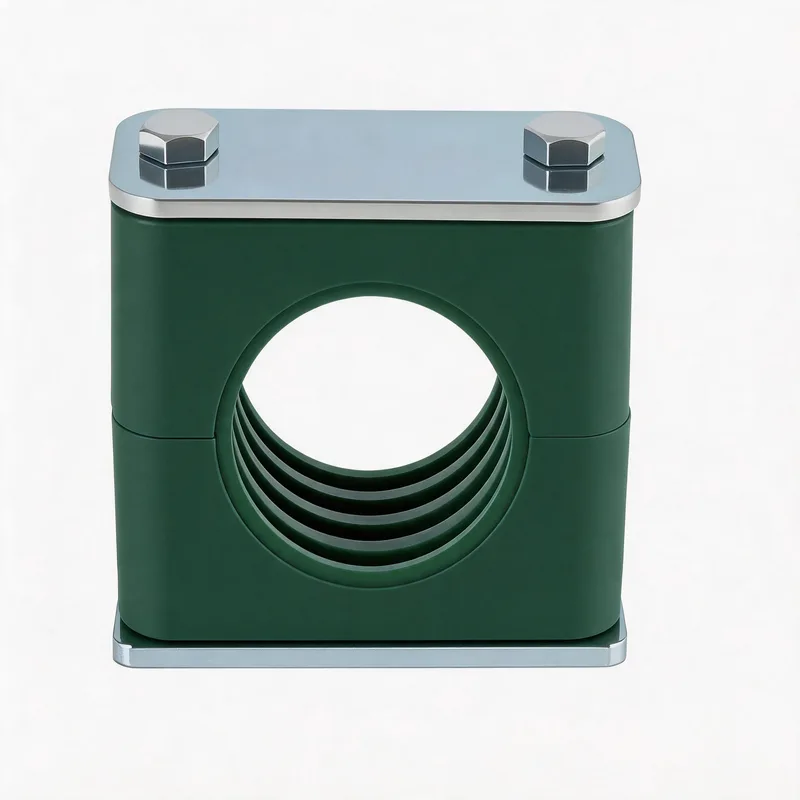
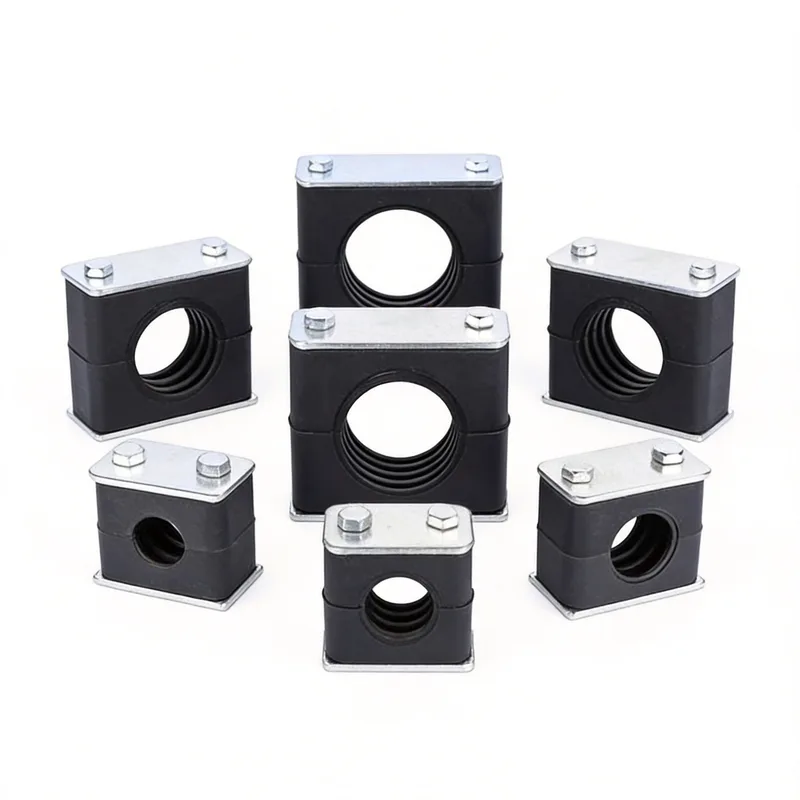
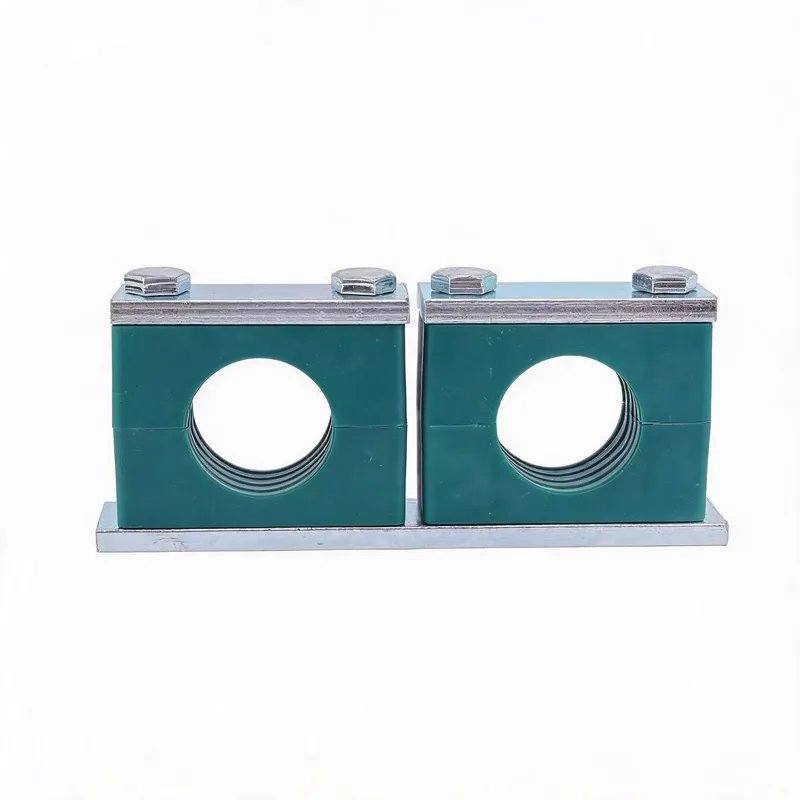
DIN 3015 defines the clamp body geometry, bore ODs, size groups, stacking bolt interfaces, rail profiles and weld-plate patterns. Any manufacturer building to the standard produces parts that assemble interchangeably with any other. A group 3 clamp for a 25 mm tube from one maker fits the same rail, the same weld plate and the same stacking bolt as the equivalent from another. If a supplier cannot state group-for-group interchangeability plainly, that is a qualification failure — not a limitation of the standard.
What actually differs: the three real risk areas
First, material verification: the standard defines dimensions, not the polymer batch or bolt steel in the box. Brands enforce this with internal systems; with a new manufacturer you enforce it with certificates — EN 10204 3.1 for metal parts, material data sheets for polymers, and independent test reports where corrosion or pressure matters. Second, consistency across orders: one good sample proves capability, not repeatability; ISO 9001 plus a stated inspection regime (and the right to audit) is what covers order two through twenty. Third, engineering communication: brands publish thick catalogs; a good manufacturer must instead answer technical questions quickly and precisely in your language. Test this during the RFQ — response quality before the order predicts support quality after it.
When staying with the European brand is the right call
Three situations genuinely favour the original brand. If the project specification names the brand and the end customer will not sign a substitution approval, the commercial saving is not worth the contractual exposure — pursue approval on the next project instead. If you need one or two pieces tomorrow, a local distributor shelf beats any factory. And if your annual volume is tiny, the qualification effort may cost more than it saves. Everywhere else — recurring volume, kit consolidation, custom parts, documentation-heavy projects — the comparison deserves to be run on facts.
The qualification checklist (apply it to us too)
Ask any candidate manufacturer for: (1) ISO 9001 certificate with valid scope; (2) EN 10204 3.1 material certificates on metal parts, available per order; (3) dimensional inspection reports against DIN 3015 tolerances; (4) salt-spray or coating test evidence if the service is corrosive; (5) a stated interchangeability confirmation for your existing part numbers; (6) two or three export references in your region; and (7) a paid trial order path with agreed acceptance criteria. A manufacturer that answers all seven quickly is qualified; one that stalls on any of them has answered a different question.
Compare landed cost, not unit price
A 50% lower unit price does not mean 50% savings, and comparing quotations line-by-line on unit price alone misleads in both directions. Build a landed-cost model per year, not per piece: unit price × annual volume, plus sea or air freight (clamps are dense — sea freight per piece is usually small at pallet quantities, but urgent air shipments erase much of the saving), plus import duty for your tariff code, plus the one-time qualification cost (trial order, inspection time, engineering review), plus a realistic estimate of inventory you must hold to cover the longer replenishment cycle. For a buyer using a few hundred clamps a year the qualification overhead dominates and the switch may not pay; from a few thousand pieces a year upward the model typically turns strongly positive within the first year. Do the arithmetic with your own numbers before deciding either way — and ask the candidate manufacturer to quote DAP or DDP so freight and duty are visible in the same line.
The switching process, step by step
A low-risk switch is a sequence, not a leap. Step 1: send the incumbent part numbers, drawings or a marked-up catalog page with quantities — a capable manufacturer confirms group-for-group interchangeability line by line, flags anything that is not a true equivalent, and quotes against the same specification level. Step 2: place a paid trial order of one or two size groups with written acceptance criteria (dimensions against DIN 3015 tolerances, material certificates, coating thickness, assembly fit on your rail or weld plates). Step 3: run the trial parts in a non-critical position for one maintenance cycle while the incumbent still supplies critical lines. Step 4: expand to full volume on the qualified groups and keep a small safety stock during the first two or three replenishment cycles. Step 5: only after a full year of stable orders, consolidate documentation, pricing tiers and an annual frame agreement. Most failed switches skip steps 2 and 3 — the trial is where a paper-qualified supplier proves or disproves itself at almost no cost.
Documentation mapping: what to request instead of the brand name
Much of what a European brand name silently guarantees can be requested explicitly as documents. Brand metallurgy becomes an EN 10204 3.1 certificate per melt for bolts, plates and rails. Brand polymer quality becomes the material data sheet with the actual polymer grade (PP-H, PA6, PA66-GF30) plus, where relevant, UV or low-temperature test data. Brand corrosion protection becomes a stated coating system (zinc plating thickness in microns, or hot-dip class) with salt-spray hours from an independent lab. Brand consistency becomes the ISO 9001 scope plus a per-order dimensional inspection report. Brand liability becomes product liability insurance confirmation — worth asking about and rarely requested. Listing these in your RFQ costs one email and converts an emotional brand-versus-noname decision into a checkable specification. It also disciplines the comparison: if the incumbent brand cannot show one of these documents either, you have learned something useful about what you were actually paying for.
Frequently asked questions
Are Chinese DIN 3015 clamps really interchangeable with European brand clamps?
Dimensionally yes, when both are built to DIN 3015: size groups, bore diameters, rail profiles, weld-plate patterns and stacking interfaces are defined by the standard, so a same-group same-OD clamp is a drop-in replacement. What the standard does not guarantee is material quality and consistency — verify those with EN 10204 3.1 certificates, material data sheets and a trial order.
How much can I realistically save by switching to a Chinese manufacturer?
Unit prices commonly run 30-60% below European brand list prices at volume, but compute savings on landed cost: add freight, duty, one-time qualification effort and extra safety stock for the longer replenishment cycle. Below a few hundred pieces per year the switch often does not pay; from a few thousand pieces per year the net saving is usually substantial within the first year.
When should I stay with the original European brand?
Three cases: the project specification legally names the brand and no substitution approval is available; you need one or two pieces urgently from a local distributor shelf; or your annual volume is too small to justify qualifying a new supplier. In recurring-volume, custom-part and documentation-heavy scenarios, a qualified manufacturer comparison is worth running.
Related WeiQue series
Recommended reading
References
These pages summarize public standard metadata and industry application information. They do not reproduce the paid DIN standard text.