
When buyers compare pipe clamp quotations, the unit price is only part of the picture, and a lower headline number does not always mean a lower total cost. The price of a DIN 3015 pipe clamp is built up from several factors — the body material, the series, the size, the fastener grade and coating, and any certification — and the total cost of a delivered order also depends on quantity and minimum order, lead time, exactly what is included in the price, and packaging and logistics. Understanding these factors lets a buyer read a quotation correctly, compare offers on a like-for-like basis, and provide the right information up front so the quote is accurate the first time. This guide explains what drives the cost of a DIN 3015 clamp and how to procure it efficiently, written from the supplier side to make the commercial picture transparent. It complements the technical selection guides: those tell you which clamp you need, this one tells you what it costs and why, and how to buy it without surprises.
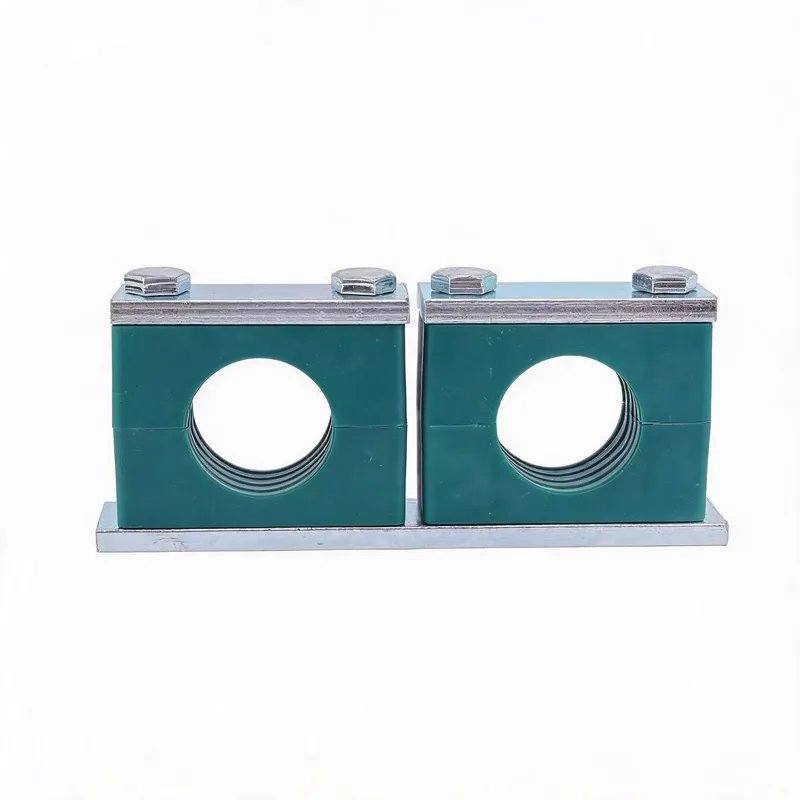
Related product photos
Key points
- Unit price is driven mainly by body material, series, size, fastener grade/coating and certification — each can move the price substantially
- Quantity matters: higher volumes lower the unit price, and very small orders may carry a minimum-order or setup cost
- The lowest unit price is not always the lowest total cost — lead time, what is included, packaging and freight all count
- An accurate quote needs accurate inputs: give series, size or pipe OD, material, finish, quantity, certification and destination up front
| Cost Factor | Lower-Cost End | Higher-Cost End | Why |
|---|---|---|---|
| Body material | PP | Glass-filled PA66 / metal | Material cost and processing differ widely |
| Series | Part 1 standard | Part 2 heavy / Part 3 twin | More material and larger hardware |
| Fastener finish | Zinc-plated steel | 316L / duplex stainless | Stainless raw material costs far more |
| Certification | None / 2.1 declaration | EN 10204 3.1 / 3.2 | Batch testing and documentation add cost |
| Quantity | High volume | Very small / sample order | Setup and handling spread over fewer units |
These are directional indications, not a price list. The actual price depends on the specific combination and current material costs. The point is that each factor is a lever — changing the material, series, finish or certification level changes the price, so specifying only what the application genuinely needs avoids paying for capability that is not required.
What drives the unit price
The unit price of a DIN 3015 pipe clamp is built up mainly from five factors. The body material is often the largest single driver: polypropylene (PP) is the most economical, polyamide (PA) costs more, glass-filled PA66 and metal bodies more still, because the raw material and processing differ. The series sets how much material and how large the hardware is: a Part 1 standard clamp uses less material than a Part 2 heavy clamp of the same nominal size, and a Part 3 twin clamp holds two pipes in one larger body. The size (group) scales the price within a series — larger groups use more material and bigger bolts. The fastener grade and coating can move the price significantly: zinc-plated carbon steel is the baseline, while stainless A2/A4 and especially duplex cost substantially more because of the raw stainless price, and premium coatings (hot-dip galvanizing, Dacromet) add process cost. Finally, certification adds cost when required: a basic declaration is inexpensive, while EN 10204 3.1 or 3.2 certificates involve batch testing and documentation. Understanding this build-up lets a buyer see where the cost sits and specify only what the application needs — paying for 316L and 3.1 certificates on an indoor dry line, for example, is paying for capability that is not required.
Quantity, minimum order and unit price
Quantity is one of the strongest levers on unit price. Manufacturing and handling involve fixed costs — setup, tooling changeover, inspection, paperwork — that are spread across the order, so a larger order divides those fixed costs over more pieces and lowers the unit price, while a very small order concentrates them and raises it. This is why suppliers quote price breaks at quantity thresholds and why a sample or trial order often has a higher unit price than a production run. Many suppliers also set a minimum order quantity (MOQ) per item or per order, below which they either cannot economically produce or apply a small-order surcharge. For the buyer, the practical implications are: consolidate requirements where possible to reach better price breaks; if trialling, expect the sample unit price to be higher than the eventual production price and judge the supplier on the production quote, not the sample; and ask for the price-break schedule so you can see how the unit price falls with volume and decide whether ordering a little more to reach the next break is worthwhile. Planning orders around these thresholds, rather than ordering piecemeal, can meaningfully reduce the average unit cost over a project.
Lead time and what drives it
Lead time — the time from order to delivery — is a commercial factor that often matters as much as price, and it is driven by several things. Stock items in standard configurations (common series, sizes and materials, zinc-plated) can ship quickly because they are made to stock or readily produced. Non-standard configurations take longer: a special material, a premium coating, a large or unusual size, or a custom arrangement may require dedicated production, raw material procurement or an extra process step. Certification extends lead time because batch testing and documentation must be completed before shipment. Order quantity affects lead time too — a very large order may need a longer production run, while a small order of a stocked item is fast. Logistics adds the final element: sea freight is economical but slow, air freight is fast but costly, and customs clearance adds time at the destination. For the buyer, the practical guidance is to state the required delivery date when requesting a quote, so the supplier can confirm whether it is achievable and flag anything (certification, special coating, non-stock size) that drives the lead time. Where a project has a tight schedule, choosing standard stocked configurations wherever the application allows is the most reliable way to keep lead time short.
What is included: clamp body versus complete assembly
A frequent source of confusion and mismatched quotations is exactly what the price includes. A DIN 3015 clamp assembly consists of more than the clamp body: it also needs a cover plate (the top half or weld plate), the bolt(s), and often a mounting rail or weld plate to attach it to the structure. A quotation might price the clamp body only, the body plus cover plate and bolt, or a complete assembly including the mounting hardware — and these are very different scopes. When comparing two quotations, a lower number may simply reflect a smaller scope (body only) against a complete assembly, so the comparison is not like-for-like. The buyer should confirm, for each quoted price, exactly which components are included: clamp body, cover plate, bolt(s), washers, weld plate or rail, and any accessories. The clearest way to avoid this is to specify the required scope in the enquiry — for example, request a complete assembly with mounting hardware, or state that you will supply the rail separately — so every supplier quotes the same scope. Getting this right at the quotation stage avoids the common and costly surprise of receiving clamp bodies with no way to mount them, or paying twice for hardware already included.
Packaging, logistics and total landed cost
The price of the clamps themselves is only part of the total landed cost — the full cost of getting the order to your door. Packaging matters for international shipment: clamps must be packed to survive handling and transit, and bulk packing is more economical per unit than individually packaged items, while special packaging (for example, kitting clamps by support location) adds cost but can save labour at site. Freight is a significant component: sea freight is the economical default for large orders but takes weeks, air freight is fast but expensive and usually reserved for urgent or small high-value shipments, and the choice depends on the balance of cost and schedule. Incoterms define who bears which costs and risks along the way — an ex-works (EXW) price looks lower but leaves the buyer to arrange and pay for freight, insurance and clearance, while a delivered price (such as DAP or DDP) includes more of these, so two quotes on different Incoterms are not directly comparable. Customs duties and taxes at the destination add to the landed cost and depend on the product classification and the destination country. For an accurate comparison, evaluate quotes on the same Incoterms and include freight, insurance, duties and packaging — the total landed cost, not just the ex-works unit price, is what actually determines which offer is cheaper.
How to get an accurate, comparable quotation
An accurate quotation depends on accurate inputs, and giving the right information up front avoids back-and-forth and the risk of a quote that does not match what you need. To get a precise, first-time-right price, provide: the DIN 3015 series (Part 1, 2 or 3) or enough information to determine it; the size group or the measured pipe outside diameter for each item; the body material required for the environment; the fastener grade and coating; the scope (clamp body only, with cover and bolt, or complete assembly with mounting hardware); the quantity per item, and the total order quantity so the supplier can apply the right price break; the certification level required (none, 2.1, 3.1, 3.2); the required delivery date; the destination and preferred Incoterms; and any project specification or standard the clamps must comply with. With this, a supplier can return a clear, itemised quotation with the unit price, the scope, the lead time and the commercial terms, and you can compare offers on a genuine like-for-like basis. The single most useful habit for a buyer is to standardise the enquiry so every supplier quotes the same scope, quantity and Incoterms — that is what makes a price comparison meaningful, and it is also what lets a supplier give you the keenest accurate price rather than padding the quote against uncertainty.
Related WeiQue series
Recommended reading
References
These pages summarize public standard metadata and industry application information. They do not reproduce the paid DIN standard text.