
Mobile hydraulic equipment — excavators, wheel loaders, mobile cranes, telehandlers, agricultural tractors, forestry harvesters and mining trucks — subjects pipe clamps to conditions far more severe than fixed industrial installations. The machine frame flexes under load, hydraulic cylinders generate pressure spikes that shock-load the piping, the entire machine vibrates from engine, drivetrain and ground contact, and the clamps are exposed to mud, stone impact, temperature extremes from arctic cold to desert heat, and pressure-washer cleaning. Clamp failures on mobile equipment cause hydraulic leaks that can disable the machine in the field, create environmental contamination, and pose fire risk when oil contacts hot exhaust components. This article covers the specific demands that mobile equipment places on pipe clamp selection, mounting, and maintenance.
Related product photos
Key points
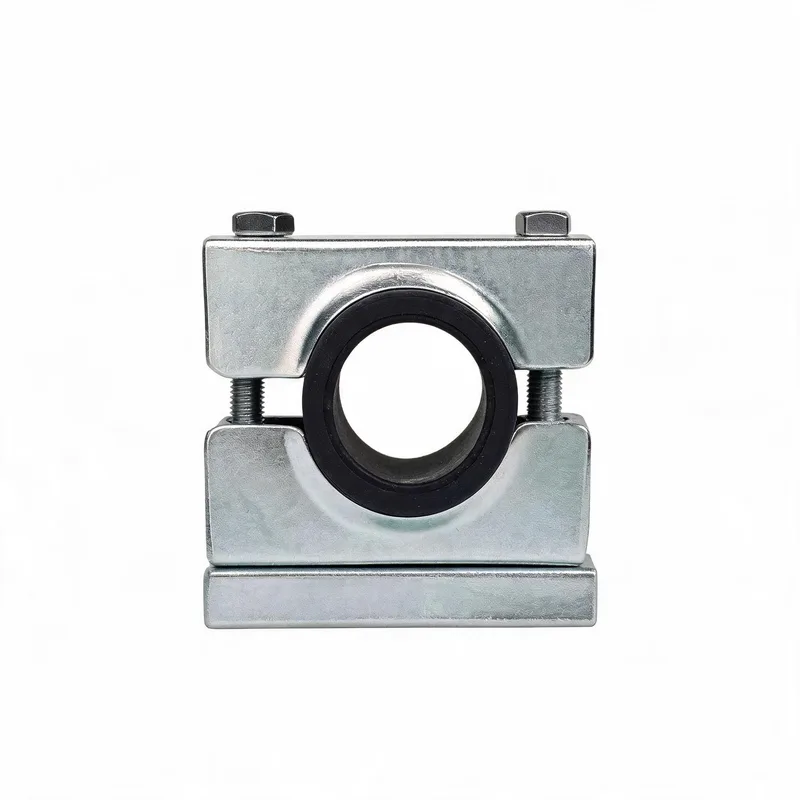
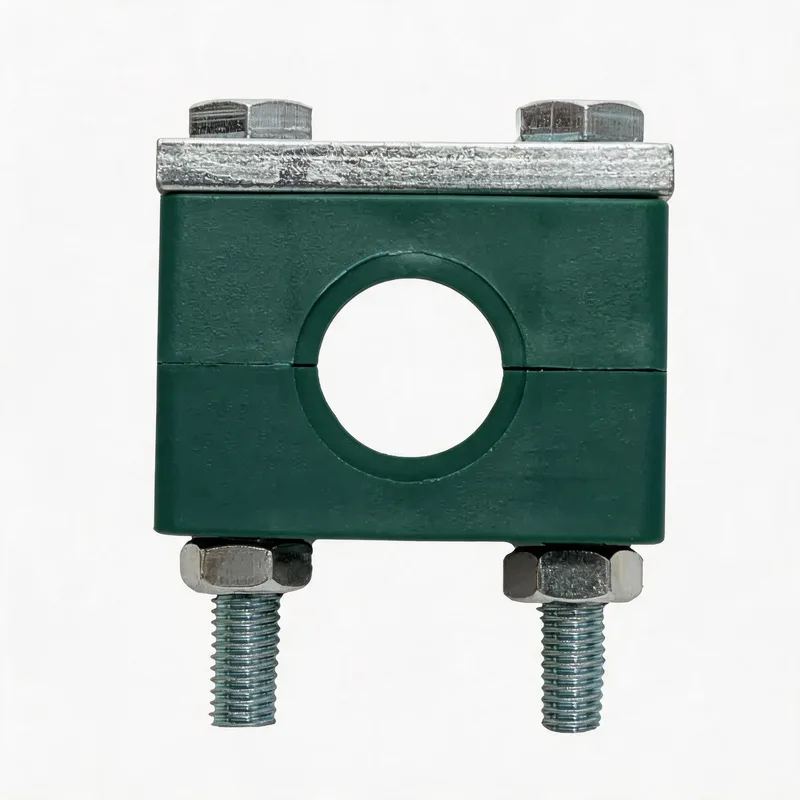
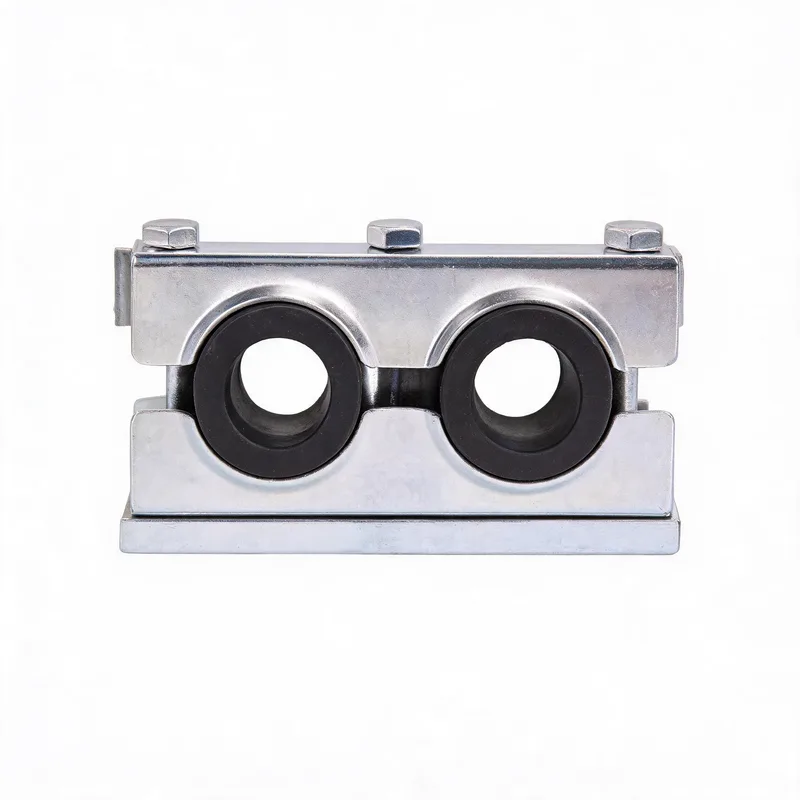
- DIN 3015 Part 2 heavy series with steel weld plates is the baseline for mobile hydraulic — Part 1 PP bodies crack under shock and stone impact
- Cushioned inserts (PA or rubber-lined) absorb frame-transmitted vibration that would fatigue-crack rigid metal-to-metal contact
- Bolt locking is mandatory — Loctite 243 or Nord-Lock washers on every clamp bolt, re-torqued after 50 operating hours
- Route hydraulic lines away from heat sources (turbo, exhaust manifold, DPF) and protect with heat shields where proximity is unavoidable
| Machine Type | Primary Challenge | Recommended Clamp | Key Detail |
|---|---|---|---|
| Excavator / loader | Shock loads from digging + stone impact on boom lines | Heavy series steel with cushion insert + protective sleeve on exposed runs | Clamp spacing ≤ 20 × OD on boom sections due to dynamic loads |
| Mobile crane | Telescoping boom extends/retracts — lines must accommodate length change | Guided clamps at each boom section + flexible hose at telescope joints | Never fix both ends of a line that crosses a telescope joint — one end must slide |
| Agricultural tractor | Dust, crop debris, fertiliser/chemical splash, seasonal storage | Heavy series with Dacromet/Geomet bolts + rubber insert for anti-vibration | Inspect clamp bolts before each season — corrosion during idle storage loosens preload |
| Forestry harvester | Extreme vibration from saw head + branch/log impact on lines | Twin clamps for parallel lines + full steel guards on exposed hoses | Use spiral wrap or chain guard on hoses between clamp points |
| Mining dump truck | Extreme dust, high ambient temperature near engine bay, very long service intervals | Heavy series 316L stainless on engine bay lines + steel with HDG on chassis runs | High-temperature PA inserts (PA 12) rated to 120 °C near engine — standard PP fails above 80 °C |
All mobile equipment clamps should be re-torqued after the first 50 hours of operation and inspected at every scheduled service interval. Clamp bolts on mobile equipment loosen faster than on fixed installations due to continuous vibration and thermal cycling.
Shock loads and frame flex on mobile machines
Unlike fixed industrial piping supported by rigid steel structures, hydraulic lines on mobile equipment are mounted to frames, booms and arms that flex under working loads. An excavator boom deflects visibly when the bucket hits hard ground; a crane boom flexes when the load swings; a loader frame twists when one wheel drops into a hole. Every frame deflection transmits a bending or shear load to the clamps mounted on it. If the clamp is rigid (metal-to-metal, no insert) and the pipe cannot move relative to the frame, the clamp body or the bolt takes the full deflection load as a fatigue cycle. Over thousands of cycles per shift, this causes crack initiation at the bolt hole or at the weld toe of the mounting plate. The solution is to allow controlled movement: use cushioned inserts that let the pipe deflect slightly within the clamp bore, and distinguish between fixed points (where the pipe is deliberately locked to the structure) and guided points (where the pipe can slide axially). On a typical excavator boom, one fixed clamp at the boom root and guided clamps along the length allows the pipe to accommodate boom flex without fatigue loading the clamps.
Vibration, bolt loosening and locking strategies
Mobile equipment generates vibration from multiple sources simultaneously: engine firing pulses, drivetrain gear mesh, hydraulic pump ripple, track or tyre impact on uneven ground, and work-tool impact (hammer, bucket, saw). These vibration spectra overlap and create complex loading that loosens conventional bolted joints more effectively than single-frequency vibration in fixed installations. Standard spring washers are ineffective against transverse vibration — they flatten under preload and provide no locking function. For mobile hydraulic pipe clamps, use one of: medium-strength threadlocker (Loctite 243 or equivalent) applied to clean, oil-free threads before assembly; Nord-Lock wedge-locking washers that create a mechanical ramp preventing rotation; or serrated-flange bolts that bite into the clamp body or mounting plate. Whichever method is chosen, apply it consistently to every clamp bolt on the machine — a single un-locked bolt in a run of locked ones will be the failure point. Re-torque all clamp bolts after the first 50 operating hours (the bedding-in period) and at every scheduled service thereafter.
Environmental exposure: mud, dust, chemicals and pressure washing
Mobile equipment operates in environments that would be considered extreme for fixed installations: quarry dust that packs into every gap, mud that holds moisture against metal surfaces for months, agricultural chemicals (fertilisers, pesticides, herbicides) that accelerate corrosion of zinc and aluminium, and regular pressure-washer cleaning at 100–200 bar that strips protective coatings and forces water into crevices. For corrosion protection, standard electro-zinc plating (5–12 µm) is inadequate — it is stripped by the first pressure wash and provides no protection in packed mud. Hot-dip galvanized (ISO 1461, minimum 45 µm) or Dacromet/Geomet coatings survive significantly longer. For the most aggressive environments (coastal quarries, salt-spreading vehicles, marine-adjacent construction), 316L stainless hardware is the only reliable option. Mud accumulation around clamp bolts traps moisture and creates a crevice corrosion cell — design clamp mounting to allow drainage and inspect/clean during scheduled service. After pressure washing, re-apply corrosion-inhibiting spray (lanolin or wax-based) to exposed bolt heads and clamp hardware.
Heat zones: engine bay, exhaust and turbo proximity
Hydraulic lines routed through or near the engine bay are exposed to radiant and convective heat from the engine block, exhaust manifold, turbocharger housing and diesel particulate filter (DPF). Surface temperatures on exhaust components routinely reach 400–600 °C; the ambient air temperature inside an enclosed engine bay can exceed 120 °C during sustained high-load operation. Standard PP clamp bodies have a continuous service limit of approximately 80 °C and become brittle at higher temperatures. PA (polyamide) clamp bodies tolerate up to approximately 120 °C. Above this, use all-metal clamp assemblies (steel or aluminium body) with high-temperature inserts. The pipe itself is also at risk: hydraulic oil in the lines should not exceed 80–90 °C for long seal life, and a line routed too close to an exhaust manifold will heat-soak the oil. Maintain a minimum clearance of 100 mm from exhaust components, and install aluminium heat shields where clearance cannot be achieved. If a hydraulic hose contacts a hot exhaust component during a frame flex event, the hose can burn through in seconds — this is a documented cause of machine fires.
Field serviceability and standardised clamp sizes
Mobile equipment is serviced in the field — at a quarry face, a farm shed, a forest landing or a mine haul road — not in a clean workshop with overhead cranes and a full tool inventory. Pipe clamp selection should account for this: use standard DIN 3015 sizes wherever possible so that replacement parts are available from multiple suppliers worldwide, not proprietary items with 8-week lead times. Standardise bolt sizes across the machine where practical — if all clamp bolts are M8 or M10, the mechanic needs one spanner size. Avoid mixing metric and imperial fasteners on the same machine. Use bolt lengths that allow re-assembly with gloved hands in cold weather — specify bolts long enough for at least two full threads protruding beyond the nut so the mechanic can start the nut by feel. For machines operating in remote locations, carry a spare clamp kit (clamp bodies, bolts, inserts and washers for each size used on the machine) as part of the field service inventory. A hydraulic line failure caused by a broken clamp that could have been replaced in 10 minutes costs hours of downtime and a recovery trip if the spare part is not on the service truck.
RFQ data for mobile equipment pipe clamps
Send machine type and model, hydraulic system pressure, pipe/tube OD and material for each circuit (boom, swing, travel, steering, auxiliary), mounting location on the machine (boom, chassis rail, engine bay, cab structure), vibration severity (normal / high / extreme), ambient temperature range, environmental exposure (dust, mud, salt, chemicals), preferred bolt locking method, required coating specification, quantity by clamp size and circuit.
Related WeiQue series
Recommended reading
References
These pages summarize public standard metadata and industry application information. They do not reproduce the paid DIN standard text.