
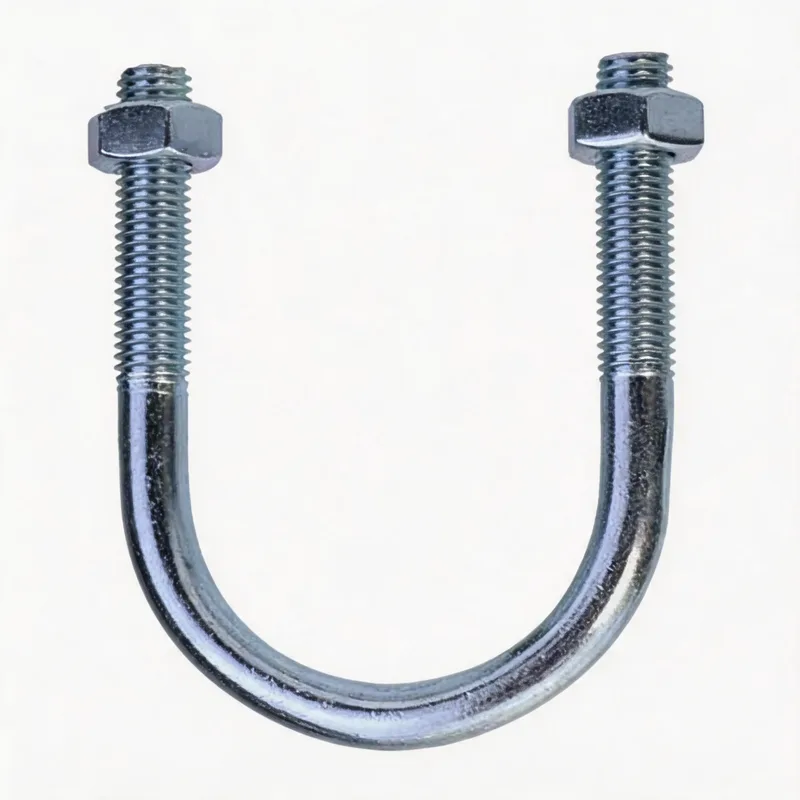
A U-bolt is one of the simplest and most widely used pipe support components: a U-shaped threaded rod that wraps around the pipe and bolts down through a support, holding the pipe to a beam, channel or plate. Its simplicity makes it economical and versatile, but it is often specified loosely — ordered by a rough size without confirming the two dimensions that actually define it, or used in places where it crushes or over-constrains the pipe. This guide explains how to select and size a U-bolt correctly: the two key dimensions that define every U-bolt, how to choose the thread size for the load, the material and coating for the environment, where a U-bolt is the right tool versus where a DIN 3015 block clamp is better, and how to install it so it restrains the pipe without damaging it. It complements the block-clamp-versus-U-bolt comparison by focusing on getting the U-bolt itself right.
Related product photos
Key points
- A U-bolt is defined by two dimensions: the inside width (must match the pipe OD) and the thread size (sets the load capacity)
- Size the inside width to the pipe outside diameter — not the nominal bore — so the U-bolt seats correctly on the pipe
- U-bolts apply point loads and can crush thin or soft pipe — use a saddle, or a block clamp, where pipe protection matters
- Match material and coating to the environment — zinc-plated for indoor, hot-dip galvanized or stainless for outdoor, coastal and marine
| Aspect | U-Bolt | DIN 3015 Block Clamp | Note |
|---|---|---|---|
| Cost | Lowest | Higher | U-bolt is the economical default for simple restraint |
| Pipe protection | Point contact (can crush) | Full-width grip with insert | Block clamp protects thin/soft pipe better |
| Vibration / damping | None (rigid metal) | Cushioned option available | Use cushioned clamp near vibration sources |
| Guided/axial movement | Hard to control | Designed for fixed/guided functions | Prefer block clamp for thermal-movement points |
| Best use | Simple restraint of robust pipe | Engineered support with defined function | Match the tool to the duty |
A U-bolt is excellent for simple, economical restraint of robust steel pipe where the support function is just "hold it down". For pipe protection, vibration control or defined fixed/guided thermal functions, a DIN 3015 block clamp is the better tool. See the block-clamp-versus-U-bolt comparison for the full decision.
The two dimensions that define a U-bolt
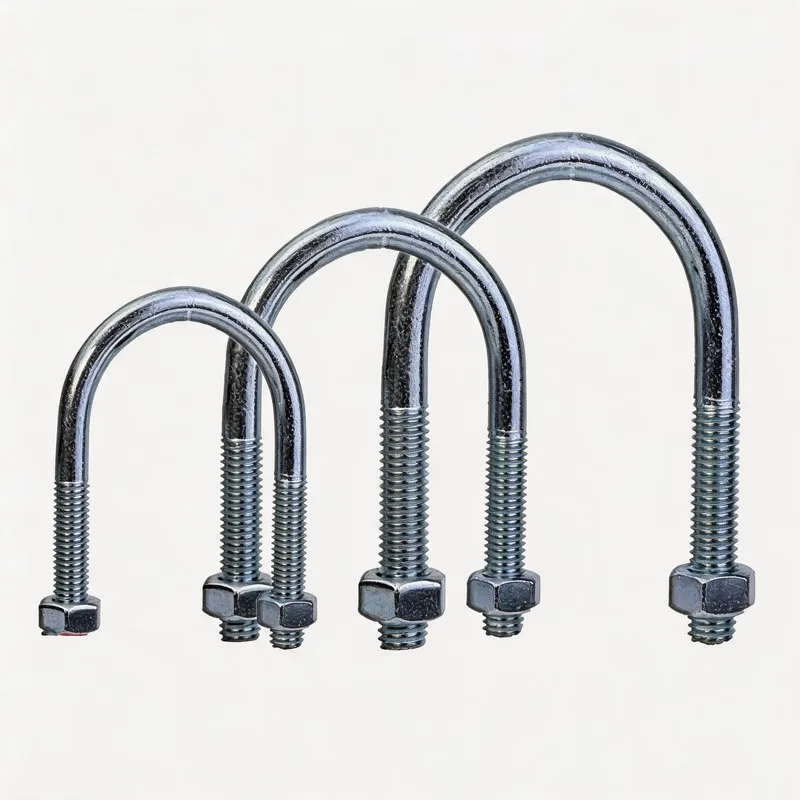
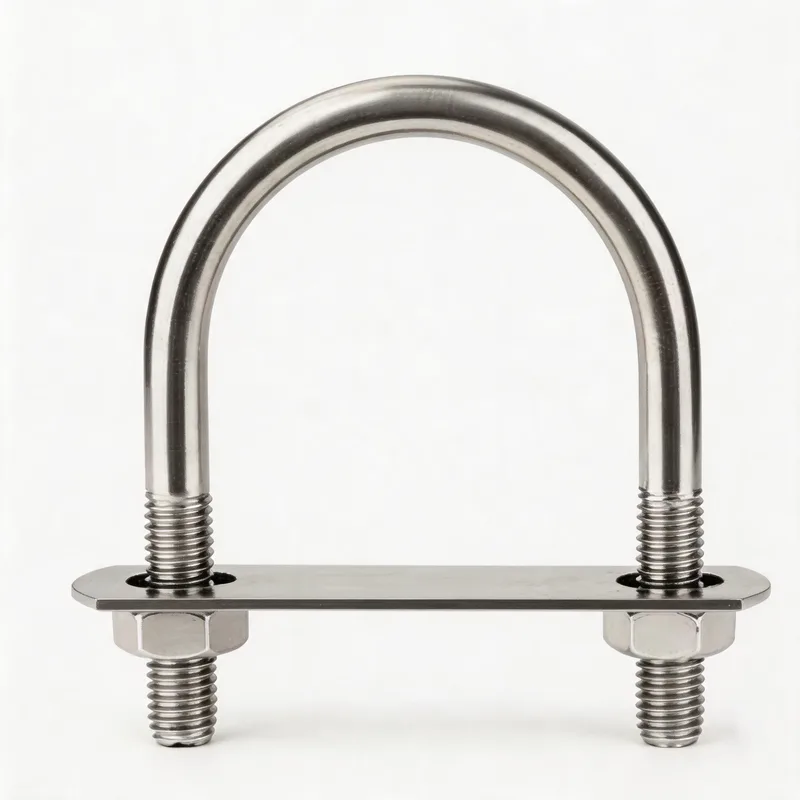
Every U-bolt is defined by two independent dimensions, and getting both right is what makes it fit and work. The first is the inside width (sometimes called the inside diameter or the gap between the legs), which must match the outside diameter of the pipe so the U-bolt wraps closely around it. Too wide and the pipe is loose in the U-bolt; too narrow and it will not fit over the pipe. The second is the thread size (M8, M10, M12, M16 and so on), which is the diameter of the threaded legs and determines the load capacity and the nut size. These two dimensions are independent: a given inside width can be available in several thread sizes, so you choose the inside width from the pipe OD and the thread size from the load. A third dimension, the leg length (how far the threaded ends extend), matters for fitting through the support and leaving enough thread for the nuts — it must be long enough to pass through the mounting plate or channel and leave at least two threads beyond each nut. When ordering, always specify all three: inside width (or the pipe OD it must fit), thread size, and leg length or the mounting thickness it must pass through.
Sizing the inside width to the pipe OD
The inside width of the U-bolt must be sized to the actual outside diameter of the pipe, and this is the most common place U-bolts are ordered wrong. As with block clamps, the trap is nominal pipe size: a pipe described as "DN 50" or "2 inch" has a nominal bore, not an outside diameter, and the actual OD is larger and depends on the pipe schedule and standard. A U-bolt ordered by nominal size rather than measured OD can be too small to fit or too large to grip. Always measure the pipe OD (or take it from the pipe data sheet) and select the U-bolt whose inside width matches that OD. For insulated pipe, the U-bolt must clear the insulation outside diameter, which is much larger than the bare pipe — although in practice insulated pipe is usually better supported by a clamp over a load-bearing insulation segment than by a U-bolt. A small amount of clearance is normal so the U-bolt slides over the pipe, but it should be close: too much gap means the pipe can move and rattle within the U-bolt before it is tightened, and even after tightening a loose fit gives poor restraint. If the exact OD falls between standard U-bolt widths, choose the nearest size that fits over the pipe and takes up the gap on tightening.
Choosing the thread size by load
The thread size of the U-bolt sets its load capacity, and it should be chosen for the load the support carries with an appropriate safety margin. The load on a U-bolt is mainly the weight of the pipe span it supports — the pipe, the fluid and any insulation — plus any lateral or dynamic loads. A larger thread size gives a higher capacity: the two threaded legs share the load in tension, and a bigger diameter has more cross-sectional area and so more strength. For light pipe and short spans, a small thread size (M8, M10) is adequate; for heavier pipe, longer spans or where the U-bolt also resists lateral or upward loads, a larger thread (M12, M16 or more) is needed. As with any threaded fastener, the U-bolt should be loaded in tension, not relied on for shear, and the whole load path — the U-bolt, the mounting plate or channel, and the structure — must be rated for the load, since the weakest link governs. The thread size also determines the nut size and the hole size needed in the mounting. Where the load is significant or the application is critical, confirm the U-bolt load rating from the manufacturer rather than guessing from the thread size alone, because the rating also depends on the material grade and the bend geometry.
Material and coating for the environment
A U-bolt is a metal component in direct contact with the environment and, often, the pipe, so its material and coating must suit the corrosion conditions over the design life — exactly as for clamp fasteners. Zinc-plated carbon steel is the economical choice for indoor, dry service. For outdoor, humid or mildly corrosive environments, hot-dip galvanized (a thicker zinc layer) or Dacromet/Geomet coatings last much longer. For coastal, marine, chemical or washdown environments where chlorides attack zinc and carbon steel, stainless steel U-bolts (A2/304 for moderate, A4/316 for marine and chloride exposure, duplex for the most aggressive) are the reliable choice. Two corrosion mechanisms specific to U-bolts deserve attention. First, galvanic corrosion: a U-bolt in direct metal-to-metal contact with a dissimilar pipe (for example a zinc-plated U-bolt on a stainless or copper pipe) can drive galvanic corrosion at the contact point — match the metals or isolate them with a rubber-lined saddle. Second, the contact line: a bare metal U-bolt bearing directly on a coated or painted pipe can wear through the protective coating at the contact, starting corrosion on the pipe itself; a rubber or plastic saddle, or a coated U-bolt, protects the pipe surface. Match the U-bolt material and coating to the pipe and the environment, not just to cost.
U-bolt or block clamp: choosing the right tool
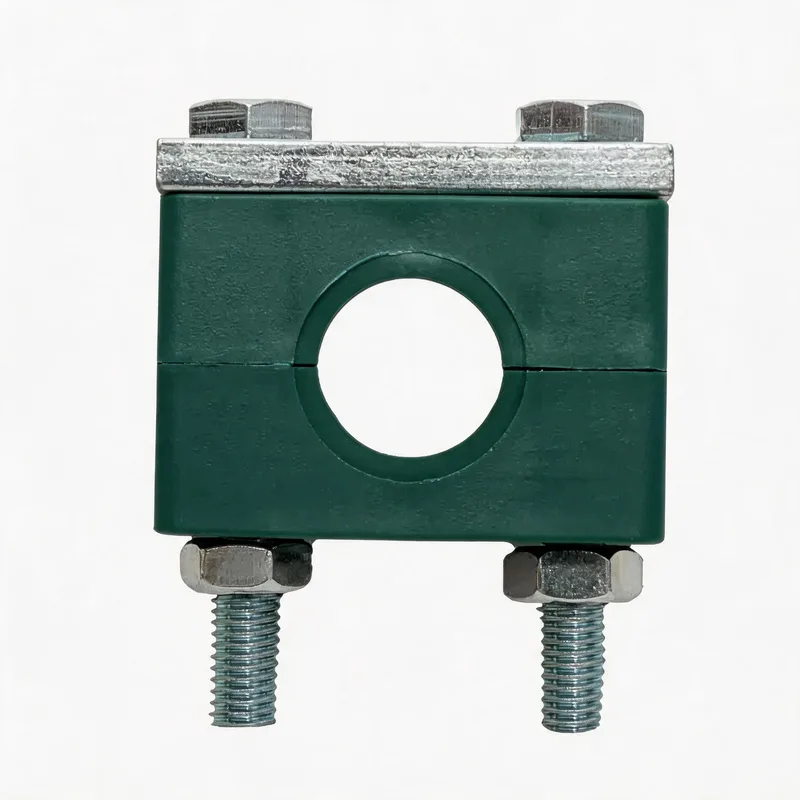
A U-bolt and a DIN 3015 block clamp both hold a pipe, but they suit different duties, and choosing the right one avoids both over-spending and under-performing. A U-bolt is the right tool for simple, economical restraint of robust pipe where the job is essentially to hold the pipe down to a support: low cost, quick to fit, and entirely adequate for sound steel pipe carrying ordinary loads in an undemanding location. A block clamp is the better tool where more is needed: it grips the pipe over a full width rather than at a contact line, so it protects thin-walled, soft, coated or polished pipe that a U-bolt could dent or crush; it offers cushioned (anti-vibration) versions that damp vibration a rigid U-bolt would transmit; and it is designed to deliver defined fixed and guided support functions for thermal movement, which a U-bolt cannot do well. So the decision is driven by the duty: choose a U-bolt for simple restraint of robust pipe where cost matters and the application is undemanding; choose a block clamp where pipe protection, vibration control, or a defined thermal-movement function is required. The dedicated block-clamp-versus-U-bolt comparison sets out the full trade-off; the short rule is to use the U-bolt where simple is sufficient and the block clamp where the application asks for more.
Installing a U-bolt without crushing the pipe
The most common installation mistake with U-bolts is over-tightening, which crushes or deforms the pipe. Because a U-bolt bears on the pipe along two narrow contact lines, the clamping force concentrates there, and on thin-walled, soft (copper, aluminium, plastic) or polished pipe it is easy to dent the wall or ovalise the pipe by tightening too hard. The aim when tightening a U-bolt is to restrain the pipe, not to clamp it immovably: tighten the nuts evenly until the U-bolt holds the pipe firmly against its support, then stop — there is no benefit to further force and a real risk of damage. For pipe that needs protection, fit a saddle (a curved metal or plastic seat between the U-bolt and the pipe) or a rubber-lined U-bolt, which spreads the load and protects the surface. Where the pipe must be allowed to slide for thermal movement, do not over-tighten the U-bolt into a fixed grip — either leave a controlled clearance or, better, use a clamp designed for the guided function. Tighten the two nuts evenly so the U-bolt seats squarely and the load shares between the legs, use a locking method (lock nuts, threadlocker or disc-spring washers) where vibration is present, and leave at least two threads beyond each nut. Installed this way, a U-bolt gives reliable, economical restraint without damaging the pipe.
Related WeiQue series
Recommended reading
References
These pages summarize public standard metadata and industry application information. They do not reproduce the paid DIN standard text.