
Desert environments — the Arabian Gulf, North Africa, the American Southwest, Central Asia, and inland Australia — subject pipe clamp materials to a combination of stresses rarely encountered in temperate industrial settings. Ambient air temperatures routinely exceed 50 °C in summer, and steel surfaces exposed to direct sunlight can reach 80–90 °C through solar gain alone, before any process heat is added. At night, temperatures may drop to 10–15 °C, creating a daily thermal cycle of 40–70 °C that fatigues polymer bodies and loosens bolted joints. Intense UV radiation degrades unprotected polypropylene and polyamide over months rather than years. Windblown sand and dust act as an abrasive that strips coatings and accelerates metal wastage. And in the Gulf region, many petrochemical complexes sit within a few kilometres of the coastline, adding salt-fog corrosion to the list. This article covers each of these stresses and the material choices that address them for reliable pipe clamp service in desert installations with a 20–30 year design life.
Related product photos
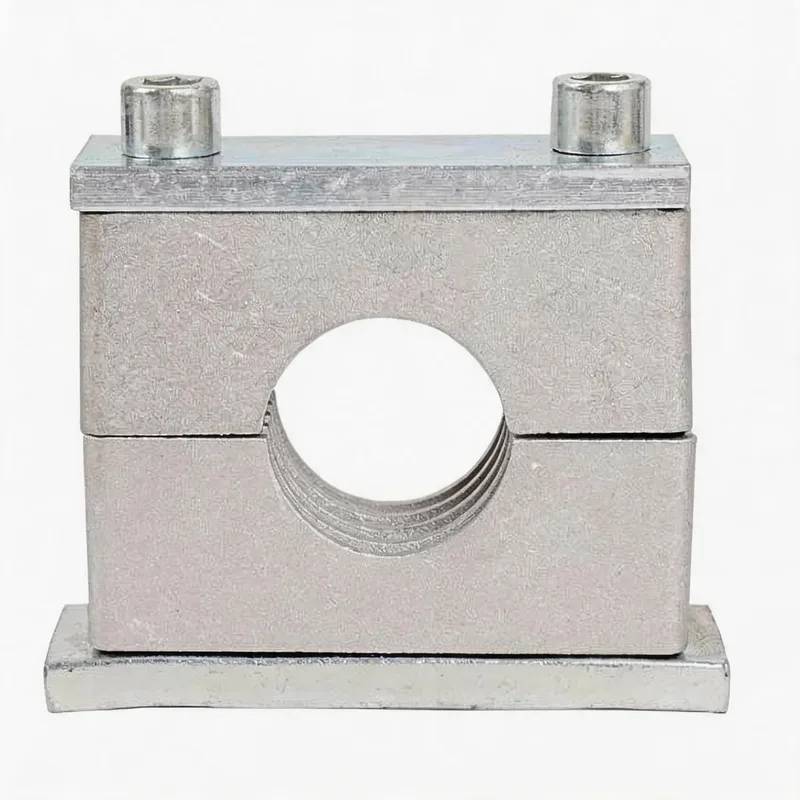
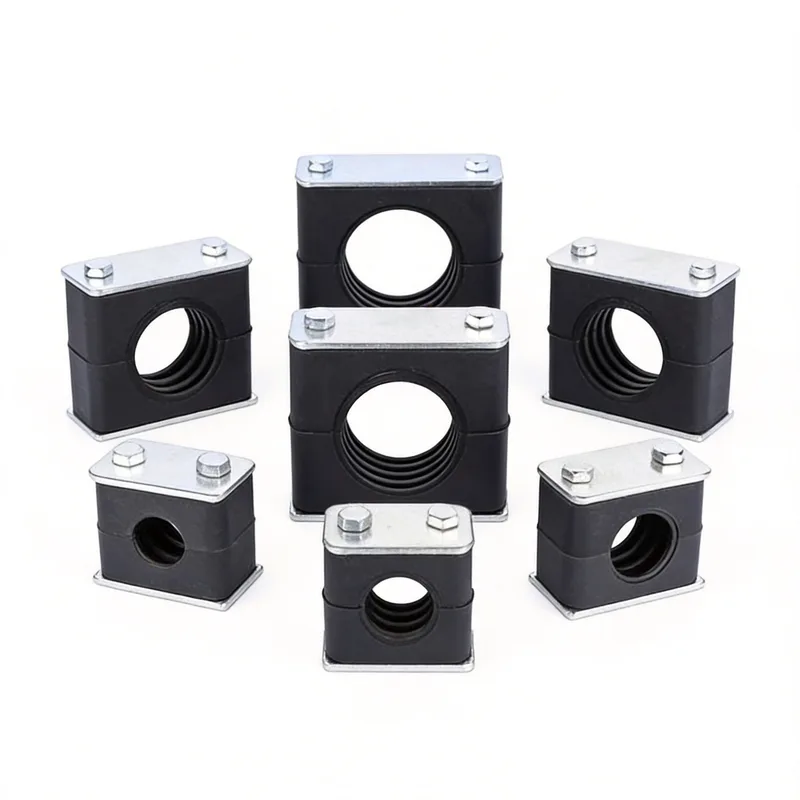
Key points
- Standard PP clamp bodies reach their 80 °C service limit from solar gain alone in desert summers — PA or metal bodies are required for exposed outdoor runs
- UV-stabilised black PA (PA6 or PA12 with carbon black) is the most cost-effective polymer for long-term desert outdoor service
- Bolt coatings must survive sand abrasion: hot-dip galvanized (≥ 45 µm) or Dacromet/Geomet minimum — electro-zinc is stripped within 2–3 years
- Gulf coastal plants within 5 km of the sea require 316L stainless hardware regardless of the pipe material to resist chloride corrosion
| Desert Stress | Effect on Clamps | Material Solution | Design Life Impact |
|---|---|---|---|
| Ambient heat (50–65 °C air) | PP softens and creeps, losing clamping force; bolts lose preload from thermal relaxation | PA or aluminium bodies; re-torque schedule | PP fails in 3–5 years; PA lasts 15–20 years |
| Solar UV radiation | PP and natural PA become brittle and crack; surface chalking | Black PA with carbon-black UV stabiliser; or metal bodies | Unprotected PP cracks in 1–2 years of direct desert sun |
| Sandstorm abrasion | Thin coatings stripped from bolt heads; pipe contact surfaces worn | HDG or Dacromet bolts; rubber-lined clamps protect pipe surface | Electro-zinc bolts lose coating in 2–3 years vs 10+ for HDG |
| Diurnal thermal cycling (ΔT 40–70 °C) | Differential expansion loosens bolts; polymer fatigue at clamp bore | Spring-disc washers or Nord-Lock; PA12 (better fatigue than PA6) | 10,000+ thermal cycles per year — bolt preload check every 6 months |
| Coastal salt fog (Gulf, Red Sea) | Chloride pitting on stainless, rapid zinc consumption, crevice corrosion under clamps | 316L or duplex hardware; PP/PA bodies (immune to chloride) | Zinc hardware fails in 3–5 years at < 1 km from coast |
Many Gulf petrochemical sites experience all five stresses simultaneously. Material selection must address the worst combination, not each stress in isolation. A clamp that survives heat but not salt fog will still fail.
Ambient temperature and solar gain: PP vs PA vs metal
The published maximum continuous service temperature for standard PP (polypropylene) pipe clamp bodies is approximately 80 °C. In a desert environment, ambient air temperature alone can reach 50–55 °C in summer. A steel pipe carrying process fluid at 40–60 °C adds conductive heat through the clamp bore. Solar radiation on the clamp body adds radiant heat — a dark-coloured object in direct desert sunlight absorbs enough energy to raise its surface temperature 20–30 °C above ambient. The combined effect means a PP clamp body on an exposed outdoor pipe run in the Middle East summer can reach 80–100 °C — at or beyond its rated limit. At these temperatures, PP softens, creeps under bolt preload, and gradually loses clamping force over weeks to months. The pipe does not fall out immediately; instead, it becomes loose in the clamp and begins to vibrate, chafe, and eventually wear through. PA (polyamide / nylon) has a continuous service temperature of approximately 100–120 °C depending on grade (PA6 vs PA12 vs PA66), providing adequate margin for most desert ambient conditions. For pipe runs adjacent to furnaces, flares or high-temperature process equipment where combined temperatures exceed 120 °C, aluminium or steel clamp bodies are required. Colour matters: white or light-grey clamp bodies absorb less solar energy than black ones. If black PA is used for UV resistance, accept the higher surface temperature and verify it remains within the PA temperature rating.
UV degradation: why unprotected PP fails in 1–2 years
Ultraviolet radiation breaks the polymer chains in PP and PA through photo-oxidation. In northern Europe, annual UV dose is approximately 80–100 kLy (kilolangley). In the Arabian Peninsula, it exceeds 200 kLy — more than double. Standard natural-colour PP (translucent white/grey) has no UV stabiliser and begins to show surface chalking and micro-cracking within 6–12 months of continuous outdoor desert exposure. Within 18–24 months, the surface cracks propagate through the wall, and the clamp body shatters under normal bolt preload or thermal cycling. PA degrades more slowly than PP under UV, but natural-colour PA still deteriorates within 3–5 years in desert conditions. The most effective UV stabiliser for polymer pipe clamp bodies is carbon black at 2–3% loading, which absorbs UV photons before they reach the polymer chains. Black PA with carbon-black UV stabiliser is the industry standard for long-term outdoor service and can last 15–20 years in desert conditions. If black colour is unacceptable for identification or specification reasons, UV-stabilised grey PA with chemical UV absorbers (HALS — hindered amine light stabilisers) is an alternative, but its service life is typically shorter than carbon-black-filled material. Never install standard natural-colour PP or PA clamps on outdoor pipe runs in a desert project — the cost of replacement after 2–3 years far exceeds the small premium for UV-stabilised material at the time of purchase.
Sandstorm abrasion and coating survival
Desert windstorms carry sand particles at velocities of 40–80 km/h, creating an abrasive blast effect on any exposed surface. Thin coatings — electro-zinc plating at 5–12 µm thickness — are stripped from bolt heads, nut faces and clamp hardware within 2–3 years of exposure, leaving bare steel that corrodes. Hot-dip galvanizing (ISO 1461, minimum 45 µm, typically 60–85 µm on fasteners) survives significantly longer because the coating is thick enough to absorb abrasive wear without exposing the substrate. Dacromet and Geomet coatings (zinc-aluminium flake, typically 8–15 µm) have better adhesion than electro-zinc and resist sand abrasion better per unit thickness, but their thinner layer means they still wear through faster than HDG. For the most demanding desert sites, consider duplex coating: hot-dip galvanized with an additional epoxy or polyester topcoat that provides both abrasion resistance and an additional corrosion barrier. On the pipe contact surface, sand accumulation between the pipe and clamp bore acts as an abrasive compound, wearing both surfaces as the pipe vibrates or thermally expands. Rubber or elastomer clamp inserts (EPDM is preferred for UV and heat resistance) trap and immobilise sand particles, preventing them from acting as a grinding medium, and should be specified for all exposed clamp locations in sandy environments.
Diurnal thermal cycling and bolt preload loss
In a desert environment, the daily temperature swing can exceed 40 °C — from a daytime peak of 55–65 °C to a nighttime low of 10–20 °C. On a pipe carrying process fluid, the cycle is even more extreme: the pipe heats up when the process runs and cools down during shutdowns, while the ambient temperature swings independently. Each thermal cycle causes differential expansion between the steel bolt, the polymer or metal clamp body, and the pipe. Steel expands at approximately 12 µm/m/°C, PP at approximately 100–150 µm/m/°C, and PA at approximately 70–80 µm/m/°C. Over a 50 °C cycle, a PP clamp body expands 6–8 times more than the steel bolt passing through it, which means the bolt preload drops during the hot phase (the body expands away from the bolt head) and is not fully recovered during the cool phase because the polymer has crept slightly. After thousands of these cycles — at a rate of one or more per day for 365 days per year — the cumulative preload loss can be significant. The practical solution is a bolt-locking method that maintains tension despite relative movement: disc-spring (Belleville) washers that store elastic energy and compensate for thermal expansion, or Nord-Lock wedge-locking washers that prevent rotation regardless of axial movement. Additionally, schedule a bolt preload check every 6 months for the first 2 years after installation, extending to annually once the joint has stabilised.
Coastal Gulf sites: chloride corrosion plus heat
The Arabian Gulf, Red Sea and parts of the North African coast combine high salinity seawater (the Gulf exceeds 40 ppt, higher than the 35 ppt ocean average), high humidity, and high temperature — a uniquely aggressive corrosion environment. Chloride ions in salt fog penetrate zinc coatings and attack the underlying steel. At high temperatures, the corrosion rate increases roughly exponentially — doubling for every 10 °C rise. A zinc-plated bolt that would last 10 years in temperate northern Europe may last only 3–4 years at a Gulf coastal plant. Standard 304 (A2) stainless steel also suffers in this environment: at chloride concentrations above approximately 200 ppm and temperatures above 60 °C, 304 stainless is susceptible to chloride stress corrosion cracking (CSCC) and pitting. 316 (A4) stainless has significantly better resistance due to its molybdenum content but is still not immune in the most aggressive splash zones. For critical long-life installations within 1–2 km of the Gulf coastline, duplex stainless steel (e.g. 2205 / 1.4462) hardware provides the best combination of strength and chloride resistance. For cost-sensitive applications further from the coast, 316L hardware with PP or PA bodies (which are entirely immune to chloride corrosion) is a practical compromise — the polymer body protects the pipe contact zone, and only the bolt heads and nuts are exposed to the salt-laden atmosphere.
Insulation, CUI risk and clamp accessibility
Many desert pipelines and refinery pipe runs are insulated — either to conserve process heat, to maintain fluid viscosity, or for personnel protection on hot lines. Insulation creates a hidden corrosion environment known as CUI (corrosion under insulation): moisture enters through jacket seams, damaged cladding or open ends, is trapped against the pipe and clamp surfaces, and cannot evaporate because the insulation prevents airflow. In desert environments, the moisture source is not rain (which is rare) but humidity, dew condensation during the cool night, and deluge fireproofing systems that drench the pipe rack during testing. The temperature range most aggressive for CUI on carbon steel is 60–150 °C — exactly the range found on many process pipes in desert plants. Pipe clamps under insulation are particularly vulnerable because the clamp body creates a geometry that traps water, and the bolt holes provide crevice sites. For insulated lines, specify 316L stainless bolts and weld plates regardless of the pipe material, apply anti-corrosion tape or paste to bolt threads before assembly, and ensure that the insulation design allows for clamp inspection and bolt re-torquing without removing the entire insulation jacket. On critical lines, include CUI inspection windows (removable insulation plugs) at clamp locations.
Specification checklist for desert petrochemical projects
When specifying DIN 3015 pipe clamps for a desert petrochemical project, confirm the following in the project specification or datasheet: (1) Clamp body material — PA with carbon-black UV stabiliser for outdoor exposed runs; PP only for indoor or shaded locations below 80 °C; aluminium or steel for locations exceeding 120 °C combined temperature. (2) Hardware material — 316L stainless within 5 km of coast; hot-dip galvanized (ISO 1461) or Dacromet for inland sites; duplex stainless for critical coastal installations. (3) Bolt locking method — disc-spring (Belleville) washers or Nord-Lock for thermal-cycling environments. (4) Rubber insert material — EPDM for UV, ozone, heat and sand resistance; NBR only for oil-contaminated environments where UV is not a factor (indoor). (5) Coating specification for weld plates and brackets — minimum hot-dip galvanized per ISO 1461; duplex (HDG + epoxy topcoat) for abrasion-exposed locations. (6) Re-torque schedule — specify in the maintenance plan: first check at 3 months, then 6-monthly for 2 years, then annually. (7) CUI provisions — 316L hardware under insulation; inspection access at clamp locations. (8) Spare parts — stock 5–10% spare clamp bodies, bolts and inserts on site for replacement of UV-degraded or sand-damaged components during scheduled maintenance. Send pipe OD list, pipe material, process temperature, ambient design temperature range, distance from coastline, design life requirement, and applicable project specification (ARAMCO, ADNOC, QatarEnergy, or client-specific) when requesting a quotation.
Related WeiQue series
Recommended reading
References
These pages summarize public standard metadata and industry application information. They do not reproduce the paid DIN standard text.